KEY POINTS
- Indonesian President Prabowo has proposed a major change to how palm oil and other commodities will be exported from Indonesia;
- The proposal puts forward a ‘single desk’ model with a state-owned enterprise handling licensing, pricing and clearance;
- Many details on implementation are yet to be made public
On 20 May 2026, President Prabowo Subianto announced that the Government of Indonesia has issued a Government Regulation (Peraturan Pemerintah, or PP) on the governance of natural-resource commodity exports, under which exports of palm oil, coal and ferroalloys are to be conducted through a state-owned enterprise (SOE) designated as the sole exporter.
The announcement came during his address on the Macroeconomic Framework and Fiscal Policy Principles (KEM-PPKF) for the 2027 draft state budget, delivered at the 19th Plenary Session of the House of Representatives (see excerpt below).
In his speech, the President said that natural-resource sales would be required to pass through a designated SOE:
“Penjualan semua hasil sumber daya alam kita, kita mulai dengan minyak kelapa sawit, batu bara, dan paduan besi (ferro alloy), kita wajibkan harus dilakukan penjualannya melalui BUMN yang ditunjuk oleh Pemerintah Republik Indonesia sebagai pengekspor tunggal.”
In English: the sale of all natural-resource output, beginning with palm oil, coal and ferroalloys, is to be conducted through an SOE appointed by the Government as the sole exporter.
He described the regulation as “a strategic step to strengthen the governance of our natural-resource commodity exports,” and stated its purpose as follows:
“Tujuan utama kebijakan ini adalah memperkuat pengawasan dan monitoring, serta memberantas praktik kurang bayar (under-invoicing), praktik pemindahan harga (transfer pricing), dan pelarian devisa hasil ekspor. Kebijakan ini akan mengoptimalkan penerimaan pajak dan penerimaan negara atas pengelolaan dan penjualan sumber daya alam kita.”
That is, to strengthen oversight and monitoring; to address under-invoicing, transfer pricing and the flight of export proceeds (devisa hasil ekspor); and to optimise tax and state revenue. The President characterised the SOE’s role as a “marketing facility” and said export proceeds would be passed on by the designated SOE to the businesses managing the underlying activity. He put the combined annual export proceeds of the three commodities at around US$65 billion.
Following the speech, Coordinating Minister for Economic Affairs Airlangga Hartarto and Investment Minister and Danantara CEO Rosan Roeslani told reporters that the SOE had been established as PT Danantara Sumber Daya Indonesia (DSI), under the sovereign fund Danantara. Bloomberg had reported the previous day that a new state entity supervised by Danantara was being prepared to manage commodity exports.
Officials described a two-stage transition.
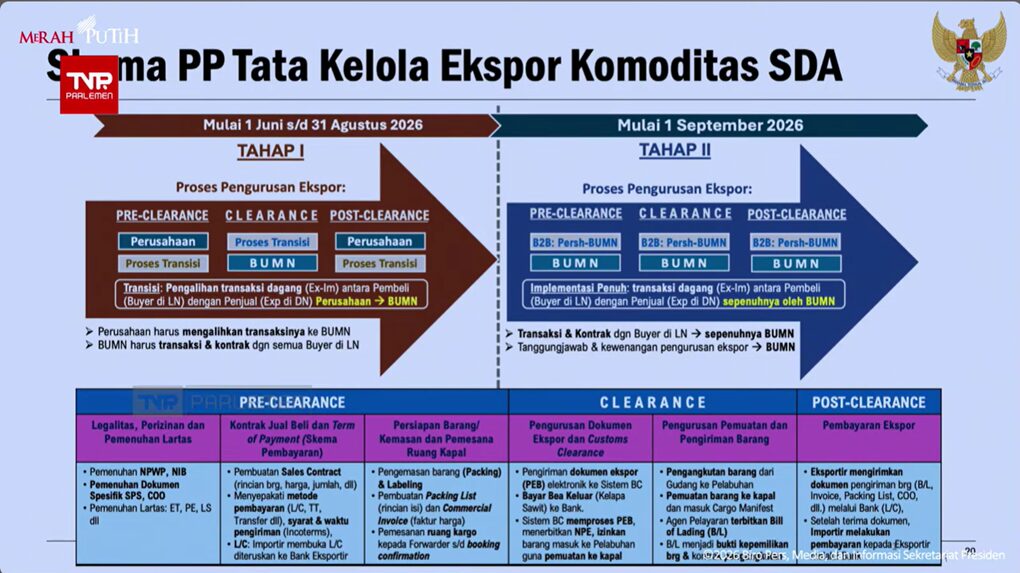
From 1 June to 31 August 2026, export transactions would continue to be conducted between companies and their buyers, while export documentation would be submitted through DSI.
From 1 September 2026, the government’s stated target is for the full export chain — contract, shipment and payment — to be handled by DSI. Rosan said each export transaction would be verified to ensure the trade value reflects the prevailing global market price.
The scheme also maps the standard export workflow that the SOE would sit within: pre-clearance (licensing and restricted-goods compliance such as NPWP/NIB, SPS, certificate of origin and Lartas permits; sales contract and payment terms), clearance (packing and documentation, electronic export declaration (PEB) to the customs system, payment of export duty, and loading with issuance of the Bill of Lading), and post-clearance (settlement of payment, typically by letter of credit).
A draft of the regulation that circulated on 20 May, reproduced in full by CNBC Indonesia, runs to six articles across five chapters — and is available here in Indonesian and English.
It defines a “Strategic Natural Resource Commodity,” lists coal and palm oil with provision to add other commodities, and states that such commodities may only be exported by the designated Export SOE. It assigns guidance and supervision to the relevant sectoral ministers. Its transitional article refers to 31 December 2026 as the date by which exports must be conducted by the SOE. At the time of writing, Palm Oil Monitor has not identified a promulgated PP number or an officially gazetted text, and treats the circulating version as a draft.
Several operational questions are not addressed in the circulating draft text and had not been clarified at the time of writing:
- the fee or margin DSI would charge, and how proceeds would be remitted to producers;
- the reference-price or valuation methodology DSI would apply;
- the treatment of export contracts already in force at the start of the transition;
- the relationship between the 1 September 2026 operational target and the 31 December 2026 date set out in the draft’s transitional provisions; and
- how the regime would interact with existing palm-oil export instruments, including the export levy and domestic market obligation.
Palm Oil Monitor will continue to track the policy and will update this post as further detail — including the final regulation text and implementing ministerial regulations — becomes available.
The relevant excerpt from the President’s speech in English is below:
The issuance of this government regulation is a strategic step to strengthen the governance of our natural-resource commodity exports. The sale of all products of our natural resources, beginning with palm oil, coal, and iron alloys, or ferro alloys, must be carried out through a state-owned enterprise appointed by the Government of the Republic of Indonesia as the sole exporter.
This means that the proceeds from every export sale will be passed on by the state-owned enterprise appointed by the government to the business operators managing those activities. This can be described as a marketing facility.
The main objective of this policy is to strengthen supervision and monitoring, and to eradicate underpayment practices, under-invoicing, transfer pricing, and the flight of export proceeds.
Ladies and gentlemen, this policy will optimise tax revenue and state revenue from the management and sale of our natural resources. With this policy, we hope that our revenue can be like Mexico’s, like the Philippines’, like that of our neighbouring countries.
We do not want our revenue to be the lowest simply because we do not dare to manage what belongs to us, what belongs to the Indonesian nation itself.
Ladies and gentlemen, in truth we must believe that all of Indonesia’s natural resources belong to the Indonesian people, to the Indonesian nation. Therefore, the state has the right to know in detail what natural resources of ours are being sold outside Indonesia. We do not want to be deceived any longer. We want to know exactly how much of our wealth is being sold.
I believe and am convinced that every citizen, especially leaders such as those present in this assembly, every leader who has common sense, intelligence, conscience, and love for the homeland, would not allow our natural wealth to continue being managed without supervision and without control. It has gone on for too long, ladies and gentlemen.
This policy has been implemented by many other countries that truly control their natural-resource wealth. We must look at and learn from Saudi Arabia, Qatar, Russia, Algeria, Kuwait, Morocco, Ghana, and even from our neighbours Malaysia and Vietnam.
We must not be naive. We must not be gullible. We must not fail to use our common sense. We must learn from countries like these. They have been able to manage their natural-resource wealth in the interests of their people.
They have succeeded in providing the best education, education that is not inferior to that of advanced industrial countries. They also have good health services, modern infrastructure, and world-class sovereign wealth funds.
We must not be ashamed to learn from countries that have long been able to use their natural resources for the greatest possible prosperity of their people.
For that reason, I emphasise that what the Indonesian government is doing today is not a strange policy, and not an extraordinary policy. This is a practice that has already been carried out by many countries. This is a policy of common sense. The natural resources belong to us. We are the ones who must determine where these natural resources are sold. We must determine what price is fair.
We do not want always to be victims and always to have to accept unfair treatment of our nation. Enough is enough. I say here that Indonesia now stands on its own feet.
In line with that, the government that I lead is also today strengthening the policy on export proceeds through a government regulation on export proceeds from the business, management, and processing of natural resources.
This policy aims to ensure that the contribution of business actors in the natural-resources sector can be optimised, once again for the greatest possible prosperity of the people.
Once again, the earth, water, and all products of Indonesia’s natural resources belong to us, to the people and the nation of Indonesia.